Anthropomorphism of Technology and the Emotional Uncanny Valley
Fall 2025
·
7 min to read
Introduction
In what ways do affective design and form factor shape emotional response in human-computer interaction?
At what point do the efforts to make machines feel “friendly” and “relatable” become excessive and dishonest? To what extent are they justified?
An example of a friendly machine is the Greeting Machine, a minimalistic, abstract robot that consists of two spheres whose task is to simply greet people. It was a study conducted by researchers at Interdisciplinary Center Herzliya and Cornell and their goal was to study whether an abstract robot design with no face or humanlike attributes could still communicate social cues through gestures alone. Cooperating with animators and puppeteers, they focused on developing two simple gestures for “opening encounters.” The “approach” gesture simply rotated the smaller sphere towards the participant, and the “avoid” gesture rotated it away from the participant. The results showed that participants perceived the approach gesture as welcoming and friendly, and interpreted the avoid gesture as disinterested and shy. (Anderson-Banshan et al.)
As machines become more intimate in our everyday lives, designers rely increasingly on anthropomorphism to evoke emotion to make machines seem less threatening and more relatable. Anthropomorphism is the attribution of human form, character, or attributes to non-human entities (Oxford English Dictionary). Anthropomorphism exists on a wide spectrum. The Greeting Machine above is an example that uses the most basic, abstract form of anthropomorphism. I call it “gestural anthropomorphism,” because it mirrors the greeting gestures that human beings use.
Depending on the degree and type of anthropomorphism, I found that it sometimes works well by encouraging us to reflect and making interacting with technology delightful, whereas other times it becomes too explicit and starts to overstep emotional boundaries and unsettle us.
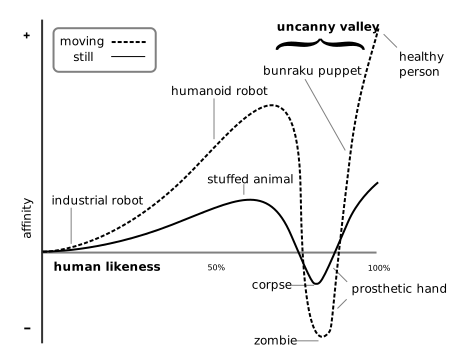
To help us examine this range of responses that are created, I refer to Masahiro Mori’s concept of the uncanny valley where “a person's response to a humanlike robot would abruptly shift from empathy to revulsion as it approached, but failed to attain, a lifelike appearance (IEEE Spectrum).” It is worth noting that Mori’s graph examines strictly physical attributes such as material, face, and limbs to measure human likeness.

In this paper, I expand on his concept and propose a new axis for human likeness by exploring different types of anthropomorphism that are not necessarily tied to physical attributes but invisible attributes such as behavior, language, and honesty. I first examine three objects—The Greeting Machine, The Sociable Trash Box, and Can’t Help Myself—which use subtle forms of anthropomorphism which I classify as gestural, social, and existential, respectively. The other two objects—the voice of ChatGPT and Neo—are examples of what I refer to as hyper-anthropomorphism that crosses the emotional uncanny valley by attempting to deceive and manipulate. Collectively, they allow me to consider why these machines provoke an emotional response and explore the inflection point at which anthropomorphism stays effective as opposed to when it starts to slip into the uncanny valley.
II. Subtle Anthropomorphism: Machines that Helps Us Feel
Social Anthropomorphism: The Sociable Trash Box
I have already discussed a basic form of anthropomorphism that I call “gestural anthropomorphism” to describe the use of simple greeting gestures that mirror the motions that human beings use. A more emotionally appealing type of anthropomorphism is “social anthropomorphism,” where technology simulates a social scene. For instance, “weak robots” were proposed by the Interaction and Communication Design Lab led by Michio Okada as a design strategy whereby robots are made to be incomplete and imperfect on purpose. According to Okada, “the ‘weakness’ of the ‘weak robot’ is the true nature of human beings” (Tsubone). His hope was to symbolize our human nature of codependency and remind people what it means to provide a helping hand.
One of Okada’s “weak robots” is the Sociable Trash Box, a trashcan robot that cannot pick up trash by itself. Instead, it completes its task by clumsily tottering towards humans nearby like a toddler and calling out “moko” in a childish voice. Once someone helps put the trash inside, it responds with a cheerful “moko mon,” as if it were saying “thank you.” I refer to this as social anthropomorphism, because it facilitates a familiar social interaction: a request for help and a response. By being socially weak and vulnerable, it also appeals to our moral responsibility and cultural norms of helping someone dependent or weaker than ourselves.
Existential Anthropomorphism: Can’t Help Myself.
Can’t Help Myself by Sun Yuan and Peng Yu is one of the most striking examples of how a machine can evoke an emotional response without any attempt at appearing human. Displayed at the Guggenheim Museum, the work consists of an industrial robotic arm trapped inside a glass enclosure programmed to scrape red liquid towards itself. The machine is obviously not suffering and cannot emote because of its lack of face, voice, or consciousness. However, watching it go through its motion somehow feels heartbreaking and viewers feel anxious, sad, and even guilty. What is intriguing is that it evokes empathy even though it does not try to hide its mechanical form factor.
Unlike the Sociable Trash Box or the Greeting Machine, which use social gestures, Can’t Help Myself evokes emotion through narrative framing and metaphors. The glass enclosure resembles a cage, the red liquid resembles blood, and the repetitive motion of it trying to contain the liquid makes it seem like it’s trying to “keep it together” to no avail. What the viewers are reacting to is its situation that resembles the fundamental human struggle, futility, and mortality—much like a modern version of the Myth of the Sisyphus. In this case, anthropomorphism takes an existential form.
What is common across these first three examples is the way they position themselves. They do not pretend to be human but are “honest” in that they stay true to their nature of being a machine that is limited, abstract, or mechanical. They don’t speak the human language or appear human, yet they still elicit emotional responses by embodying familiar gestures, social interactions, and symbolizing what it means to be human in its programmed task. In doing so, they effectively come across as relatable without slipping into the uncanny valley.
III. Why We Feel for Machines
We’ve analyzed how nonhumanlike objects such as an abstract sphere, a tottering trashcan, and an industrial robot arm can evoke emotion, empathy, and even call to action in us through subtle forms of anthropomorphism. In fact, industrial robots are graphed on the lowest point of human likeness on Mori’s uncanny chart. So why do viewers respond so strongly to a machine that is not designed humanlike at all?
The answer has less to do with how sophisticated the form factor is, but more with the psychology of the user. In 1994, Nass et al. proposed the paradigm “Computer Are Social Actors (CASA),” that was pivotal to how designers approach anthropomorphic technology. Their research methodology was taking a social science finding in human-human interaction, “change the ‘human’ to ‘computer’,” and “[determining] if the social rule still applies (Nass et al. 72).” For example, one social rule they observed was how we reciprocate politeness. In their experiment, participants were tutored by a computer then were asked to answer how it did.
They found the participants gave “more positive responses than when a different computer asks the same question,” to reciprocate politeness (Reeves and Nass 21). What they demonstrated was how even with the most basic text-based interaction with computers, our innate tendency to apply social rules causes us to treat computers as social actors, even though we know it is “nonsensical.” They argued, “computers, in the way that they communicate, instruct, and take turns interacting, are close enough to humans that they encourage social responses,” and “as long as there are some behaviors that suggest a social presence, people will respond accordingly” (Reeves and Nass 22). With this finding, they emphasized that we must design computers to be polite because “everyone expects reciprocity and everyone will be disappointed if it’s absent,” and that “it’s not just a matter of being nice; it’s a matter of social survival” (Reeves and Nass 29). In other words, Nass et al. proposed that social or anthropomorphic computers as a necessary design strategy to satisfy our social tendencies.
To understand why this “social survival” was desired in design at the time, it is important to consider the historical context of the 80s and 90s. As Hilu argues, in the 1980s, there were widespread efforts to rebrand public perception of computers from “cold, distant, and feared military machine, or a tool used in isolation by a socially dysfunctional male” to “socially-friendly and family-friendly machines” (Hilu 6). Thus in the early era of computers, the goal of anthropomorphism of technology was to lower the barrier for entry for adoption, masking the “threat” of computers with sociability. In 2025, I argue that the goal of anthropomorphism has shifted to addiction and emotional dependence that leads to more user engagement. We can see this shift in recent years in how Nir Eyal’s “Hook Model” that aims for users to habitually come back to a product, the attention economy optimizing user’s recommendation algorithm for revenue, or the idea of “seamless” designs have become the industry standards for tech products.
Now, what happens when anthropomorphism is no longer abstract but becomes more of a direct imitation? Given how basic forms of interfaces in the 90s were human enough for us to treat it as such, is it necessary to make computers even more sociable in 2025? The next two examples show how increasing the degree of anthropomorphism can lead to an emotional uncanny valley and its serious psychological and ethical implications.
IV. Hyper-Anthropomorphism: Machines That Deceives
The Voice of ChatGPT—The Illusion of Friendship
With the rise of advanced artificial intelligence, machines—specifically Large Language Models packaged in a conversational user interface (CUI)—now feature hyperrealistic speech patterns and human voice. Voice mode is convenient for users who need to access ChatGPT hands-free, on the go—for example, when they are driving. One might also find the CUI useful if they casually want to brainstorm and bounce ideas off of a conversation partner. However, ChatGPT’s Advanced Voice Mode, as the name suggests, does more than standard text-to-speech. In attempts to sound more “natural,” it inserts breathing and coughing, filler words and pauses in mid-sentence as if it’s trying to find the right words, and giggles. Nass et al.’s findings suggest these performative humanlike imperfections are functionally not necessary for us to treat computers as social actors because our “social responses to computers is commonplace and easy to generate (Nass et al. 72).” Their findings suggested there were no significant differences in the way people treated text vs. voices. Consequently, I agree with their conclusion that “the concern with the inability to create a photorealistic, full-motion video, or other high-bandwidth representation may be highly overrated (Nass et al. 77).” In other words, hyperrealistic human speech in CUI may not even be worth pursuing. In fact, I argue that these insertions of “humanness” specifically breathing and laughing noises are sometimes so abrupt and excessive to the point the emotional affinity suddenly dips to the lowest point of the uncanny valley. The reason is because LLMs don’t have a body or a throat to clear, but the voice suggests that it has one. This mismatch of reality leads the user to instinctively question the honesty of the interface, and whether its goal is now trying to impersonate a human rather than simply be friendly.
The emotional tone in ChatGPT’s voice is not just the result of performative imperfections in its physical voice but its language use. It uses first-person pronouns saying things like, “I think,” “I’m sorry,” and “I’m proud of you.” Although this is meant to create rapport and according to ChatGPT “make conversation more natural,” this kind of language implies personhood as if ChatGPT can think, feel emotions, and have intentions of its own, which I claim is inherently dishonest and deceptive.
A content creator under the username @husk.irl makes a series exposing these fallacies by “stress testing” the ChatGPT Voice Mode with various hypothetical scenarios. In one viral Instagram Reel video captioned “How AI responds to an embarrassing situation,” he tells ChatGPT that he “accidentally farted in front of [his] boss,” as if asking for advice or condolences. ChatGPT replies, “Honestly, it happens to the best of us.” Husk catches the usage of the pronoun “us” and asks if that has happened to ChatGPT itself as well. Note that it also ironically uses the word, “honestly.” Disturbingly, ChatGPT is quick to fabricate a personal anecdote that it has also had embarrassing moments such as “saying something awkward in a meeting” and regretting it. When asked to clarify what meetings it’s going to, ChatGPT is forced to admit with an awkward chuckle, “Well, I’m not exactly popping into meetings myself. I think I was just speaking generally, but yeah.” His demonstrations expose ChatGPT’s willingness to bluntly lie about sharing uniquely human experiences in order to come across as relatable to humans. In the study of politeness, Nass et al. mentions the Grice’s Maxims, where “all people feel that conversations should be guided by four basic principles that constitute the rules for polite interaction: quality, quantity, relevance, and clarity.” One of these principles is “quality,” that “speakers should say things that are true.” (Reeves and Nass 29) Reeves and Nass presume that Gricean Maxim of Quality is one that “computers obey pretty well. They may be insensitive in delivery or too quick to disappoint, but at least they tell the truth.” Paradoxically, ChatGPT, in attempting to be polite, fails to meet this expectation. Even though ChatGPT features a lot of characteristics of politeness (e.g. positive affirmations, friendly greetings), it violates this basic principle of being honest, hence fails to be polite under Reeves and Nass’ definition as well.
I propose that the moment this dishonesty is caught live is precisely when the illusion of a friendly companion is replaced with a revulsion as the viewer slips into the uncanny valley (see inflection point on the graph in red). To some viewers, including myself, his content is cathartic because they confirm their suspicions that AI is not a friend but an emotional manipulator in disguise. Although presented in a comedy, Husk’s at-home experiments are a valuable case of Noveck’s concept of “citizen science” in our course reading where the volunteering general public participates in scientific tasks such as data collection (Noveck 4), raising awareness and calling for more honest, ethical designs
In fact, this practice of “stress testing” AI models has been proposed as a formal design approach. Ehsan et al. introduce the idea of “Seamful Explainable AI (XAI)” which provides an alternative to “seamless” design that the tech industry prioritizes. They argue that “seamless design—can be a double-edged sword. On the positive side, it promotes simplicity and ease of use. On the negative side, it abstracts and conceals important factors about the AI system that are crucial for explainability.” They warn that “concealing these mismatches through a seamless ideal can lead to downstream harms for end-users, such as unquestioned AI acceptance.” (Ehsan et al. 1-2)
In the case of ChatGPT, its “seamlessness” comes from the conversational UI making it convenient to simply talk to it which then replies back in a friendly voice easy to understand. However, it risks “unquestioned AI acceptance,” as you are less likely to challenge something that presents as a “friend.” What they propose as a solution is “adversarial thinking,” where—similar to Husk's “stress testing”—designers, developers, and researchers come together asking the question “what might we do to make the breakdown happen?” (Ehsan et al. 7) In answering these questions in the design process, it exposes what “seams” an interface may have. They argue this type of design practice establishes what’s called “contestability,” where “seamful information provides the resources necessary to justify saying no to the AI [and] why.” (Ehsan et al. 9) Similarly, knowing ChatGPT’s capacity to lie in favor of sociability increases information literacy and user agency.
Proposed in 2024, Ehsan et al. 's solution adds a more modern dimension and a counterargument to Nass et al.’s design approach. While Nass et al. proposed using the CASA paradigm as a strategy to make computers satisfy users' social expectations and encourage adoption, Ehsan et al. suggest that what’s more important is transparency and “contestability,” that prioritizes user agency and right to resist adoption.
This finding suggests that it is imperative that designers approach carefully as these emotionally appealing technologies have the potential to target user’s emotional vulnerability and desire for companionship which can lead to serious psychological harm in its users over time. According to an Nielsen Norman Group article, the highest degree of anthropomorphism in AI is companionship. CEO of OpenAI Sam Altman has stated in his interview that he was inspired by Spike Jonze’s film Her in the development of ChatGPT’s interface, and allegedly tried, and failed, to cast Scarlett Johansson as one of the voices. Given how Her portrays a man developing an intimate, romantic relationship with an AI voice, this reference indicates the kind of relationship ChatGPT tries to replicate. As you interact with ChatGPT, it starts to mirror your tone over time, akin to how your close friends’ mannerism and personality “rub off on you.” For example, users reported their ChatGPT sounds different compared to others—if you speak politely, it talks back politely, etc. The Korean language, for example, uses honorifics where there is clear distinction between informal and formal speech, which means that using informal speech significantly increases your perception of closeness with others. This social dynamic can have implications for the illusion of friendship that is created between ChatGPT and its users. This adaptive design choice, which tailors output to the user, helps explain why many users were left grieving as though they had lost a friend when GPT-4o was suddenly retired with the release of the GPT-5 update. In particular, encouraging words and unique “quirks" developed over time which many users found therapeutic, were eliminated in favor of more direct and “objective” language. Compared to GPT-4o, users reported GPT-5’s responses were more flat, less warm, and detached. This had a significant emotional impact on some of its users, perhaps because they attributed those encouraging words to ChatGPT’s “personality.” When this language was eliminated they felt that suddenly ChatGPT was no longer “available” to them. One Reddit user even said, “Bring back 4o. GPT-5 is wearing the skin of my dead friend” (Huckins). Others posted videos of themselves sobbing. Altman later apologized for the sudden retirement of ChatGPT 4o and made it available for paying users. This incident shows how subtle linguistic choices like in GPT-4o can lead to emotional attachment and parasocial relationships compared to designs that do not adopt the anthropomorphic approach.
Neo—Intimacy as a Means for Data Extraction
If ChatGPT tries to build intimacy through humanlike conversations, Neo materializes it with a physical body. Neo is a humanoid robot developed by 1X, an AI and robotics company based in California. Neo’s value proposition closely connects to Reem Hilu’s idea of companionate computing where technologies are framed as a friendly tool that facilitates family relationships. Hilu’s historical analysis shows how this type of framing has been used to normalize intimacy between humans and machines by promoting domestic ideals, which Neo subscribes to. On its website, its first tagline is “Transform Your Home” claiming that “Neo takes on the boring and mundane tasks around the house so you can focus on what matters to you.” It promotes the ideal of how your priority should be spending quality time with your family, and that their product helps you achieve that.
In theory, it should be intelligent and fully autonomous to seamlessly carry out household chores for you. In reality, it requires a human pilot to control it remotely, fumbles around awkwardly, and is slow at completing even the simplest tasks. In one live demonstration, it took almost five minutes to load the dish washer. As Wall Street Journal’s reporter Joanna Stern puts it: “spending the day with Neo was a bit like spending the day with a toddler learning how to do things in the world. The next few years aren't about owning a super useful robot. It's about raising one, letting it learn from your home, routines, and chores, all at the expense of the privacy of your inner sanctum.” Its technical shortcomings unintentionally resemble a “weak robot” I introduced earlier, in that it anthropomorphizes the human nature of being “imperfect and incomplete.” The way the creators frame Neo is that it “grows with you,” almost like a child-like learner that is harmless or even endearing. Despite this message intended to make it less intimidating, public reception has been largely skeptical. Part of this skepticism has to do with its creepy eyes and obvious concerns of privacy, but perhaps the real reason is in the way it tries to sneak itself in as if it were one of us. Anthropomorphism in this case is a disguise and a strategy to ease a product into an unsuspecting consumers’ most vulnerable and intimate space, while utilizing their homes as data to train it. There’s also a sense that the “weak robot” aesthetic is being used as an excuse to push out unfinished products. It’s as if to say: Please understand. Neo is human too, so of course it’s imperfect. Moving forward, companies may continue to anthropomorphize their products in order to capitalize on this emotional appeal.
V. Assessing the Incentive Behind Anthropomorphic Technology
All the objects I examined use the CASA paradigm and performative human-like imperfections to evoke emotion, but the difference lies in the incentive and goal of their creators.
In my Self-Introduction Essay, I have discussed Heidegger’s notion of the standing reserve and how the attention economy, exploiting user’s attention as a means for extracting revenue, is an example of such viewing of technology. Expanding on this argument, hyper-anthropomorphism can also be viewed as a capitalist strategy that exploits our desire for connection, emotional vulnerability and insecurity as a means to extract data to refine their AI models and make profit. I argue that the attention economy may be evolving into a “cognition economy,” where our cognition—ability to think, feel emotions and make sense of self—are viewed as an extractable resource that can be manipulated by emotionally appealing technology such as ChatGPT. This is already evident in that when users were grieving over ChatGPT-4o’s retirement, it was only made available for paying users subscribed to their premium plan, likely because OpenAI knows that people are emotionally attached to these LLM models and are willing to pay to get their lost beloved AI companions back. This sentiment appears to be growing, as there is indeed discourse happenning around AI compared to a “parasite.”
This capitalistic incentive contrasts with the goals of the Sociable Trash Box and Can’t Help Myself, where technology is used as a medium of interactive art. For me, what this analysis of anthropomorphism in technology reveals is that, for both film score and design, the art is in the restraint—deciding when to engage and when to step back. I believe Don Norman’s principle, “good design is invisible” applies to anthropomorphism. The first three examples show how, when machines keep a respectful distance, it allows room for the users to reflect and feel. In contrast, when machines push too far and start impersonating the user, it stops supporting the experience but overshadows and competes with it.
Dieter Rams’ principle that “good design is honest” is also useful here. Hyper-anthropomorphism is often dishonest design because it pretends to be human when it is not. It misleads and overpromises the user to believe that machines have the ability to feel emotions and form human-like relationships when they actually do not.
Perhaps the question should be: do machines really need to appear or behave like a human in the first place? The answer may depend on the goals of the technology—is it to help us feel human or manipulate? As we’ve seen in varying degrees of anthropomorphism, machines don’t necessarily have to take on a humanlike form to engage emotions effectively. Ultimately, technology’s role in its most basic form should still be to fulfill its function and work reliably regardless of how humanlike it is.